
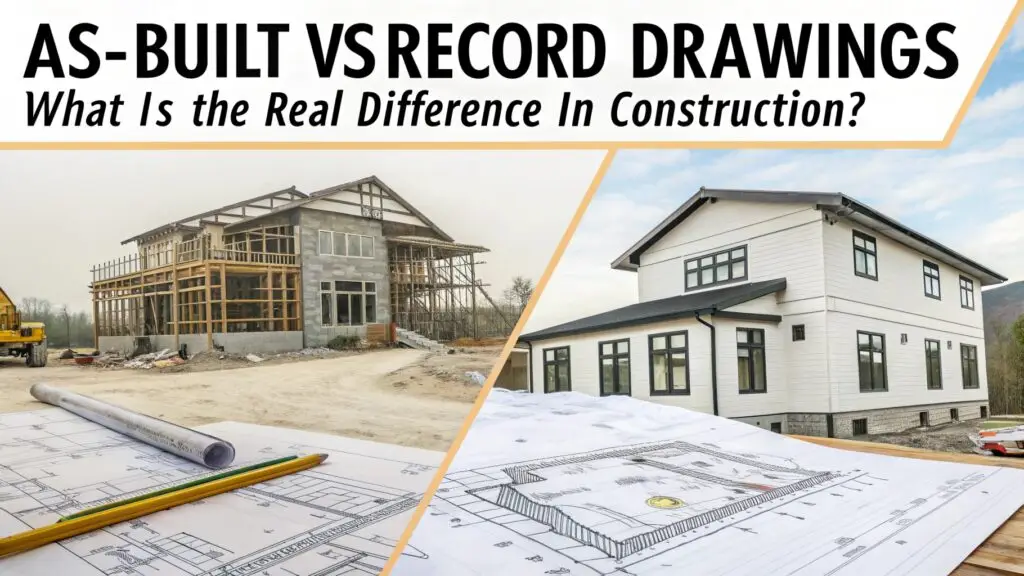
In construction, people often use as-built drawings vs record drawings as if they mean the same thing. On many projects, that casual usage creates confusion between owners, consultants, contractors, and facility teams. The result is simple but serious: teams close projects with unclear documentation, missing field changes, and incomplete handover sets.
So, are as-built drawings and record drawings the same?
No, they are not exactly the same. They are related, but they serve different purposes. Both reflect project information after or during construction, but the level of accuracy, responsibility, and practical use can vary a lot.
For anyone involved in design, coordination, execution, handover, or facility management, understanding this difference matters. It affects project closeout, maintenance planning, renovations, compliance, and future construction work. It also becomes even more important when teams use BIM Services in India, Clash Detection services, and coordinated MEP Services to deliver accurate project data.
Key Takeaways
- As-built drawings show what was actually constructed on site, including field changes.
- Record drawings are revised sets of design drawings based on marked-up information available at project closeout.
- They are connected, but they are not always identical in meaning or accuracy.
- As-built drawings usually focus more on actual installation conditions.
- Record drawings often represent the final documented version kept for owner reference.
- In BIM-led projects, the difference becomes clearer because models, site updates, and coordinated documentation can be tracked more precisely.
Why This Confusion Happens So Often on As-Built vs Record Drawings
The confusion starts because both drawing sets deal with the project after design intent meets site reality. On paper, both appear to represent the completed building. But in practice, they may come from different sources and carry different levels of reliability.
A design drawing shows what the team planned to build. A site condition rarely follows that plan with perfect accuracy. Routing changes, equipment shifts, beam conflicts, service offsets, duct reroutes, valve relocations, slab openings, and unforeseen site conditions all force changes during execution. Once those changes happen, the documentation must be updated.
That is where as-built and record drawings come in.
What Are As-Built Drawings?
As-built drawings are drawings updated during or after construction to show the actual installed conditions on site. They capture what was truly built, not only what the original design intended.
These drawings typically include:
- Actual dimensions
- Installed locations of systems and components
- Routing changes in ducts, pipes, conduits, and cable trays
- Changes in wall openings, sleeves, and penetrations
- Modified levels, elevations, or offsets
- Site-driven revisions due to clashes or constructability issues
- Approved field changes and variation work
In simple terms, as-built drawings answer this question:
What did the contractor actually build?
These drawings are highly valuable because future teams depend on them. If a maintenance contractor opens a ceiling, if a tenant fit-out team modifies MEP systems, or if an owner plans renovation work, the as-built set becomes a practical reference.
Who Usually Prepares As-Built Drawings?
In many projects, the contractor or trade subcontractor maintains these drawings. For example:
- HVAC contractor updates duct routing
- Plumbing contractors update pipe layouts and invert levels
- Electrical contractors update conduit paths, panel changes, and cable routes
- Fire protection contractor updates sprinkler lines and heads
- Civil or site teams update underground utility locations
When project teams use strong MEP Services and BIM workflows, as-built information becomes more reliable because site changes can be captured in coordinated digital models instead of only manual redline markups.
What Are Record Drawings?
Record drawings are the final documented drawings prepared from the most current available project information, often incorporating approved revisions, marked-up changes, site notes, and closeout documentation.
They are usually issued as the project’s final reference set for the owner.
In many cases, record drawings are based on:
- Original construction drawings
- Approved change orders
- Site instructions
- Consultant revisions
- Contractor redlines
- As-built markups, where available
That means record drawings may include as-built information, but they do not automatically guarantee that every field condition was independently verified on site.
In simple terms, record drawings answer this question:
What is the final documented version of the project based on the information collected at closeout?
Who Usually Prepares Record Drawings?
This depends on the contract structure and project practice. Sometimes the consultant compiles them. Sometimes the contractor submits revised drawing sets. In BIM-enabled projects, the digital coordination team may help update the final model and drawing package.
However, the key point is this: record drawings may rely on submitted information, while as-built drawings aim to reflect what was actually installed.
MUST READ: Shop Drawings to Spools: Closing the Loop with the Fabrication Shop
As-Built vs Record Drawings: The Core Difference
The simplest way to understand the difference is this:
- As-built drawings = actual site installation
- Record drawings = final documented project record
That difference may look small, but on live construction projects, it is a big deal.
1. Purpose
As-built drawings are meant to show actual construction conditions.
Record drawings are meant to preserve final project documentation.
2. Accuracy Source
As-built drawings depend on field verification and contractor updates.
Record drawings depend on compiled project records and approved changes.
3. Level of Reality
As-built drawings are closer to on-site reality.
Record drawings may be close, but only if the source data is complete and properly updated.
4. Project Use
As-built drawings are very useful for operations, renovations, maintenance, and facility teams.
Record drawings are useful for archiving, owner handover, and official documentation.
A Practical Example from MEP Construction in As-Built vs Record Drawings
Let us take a simple example from an MEP project.
The original design drawing shows a chilled water pipe running through Corridor A. During installation, the contractor finds a beam conflict and shifts the routing by 450 mm. At the same time, the duct elevation changes to avoid another trade clash, and the valve location moves for access.
Now think about documentation:
- If the site team marks those changes properly and updates the drawing to match the actual installation, that becomes an as-built drawing.
- If later the final drawing set is compiled using those updates along with other approved revisions for handover, that may become the record drawing set.
If no one captures the field change accurately, the record drawing may still look neat, but it may not fully match what is above the ceiling. That is exactly why this distinction matters.
Why This Difference Matters More in BIM Projects
On traditional 2D projects, documentation gaps are common because updates often depend on handwritten redlines, scattered emails, and manual revision workflows.
In BIM-led delivery, teams can do much better.
With modern BIM Services in India, project teams can:
- Track approved design changes faster
- Update coordinated models during execution
- Link field revisions with shop drawings
- Improve visibility across architecture, structure, and MEP
- Generate more dependable closeout documentation
- Support future asset and facility management workflows
When BIM is supported by Clash Detection services, many site changes can be reduced before installation even begins. That means fewer last-minute reroutes, fewer undocumented modifications, and better final drawing accuracy.
This is especially important in projects with dense services such as hospitals, hotels, commercial towers, industrial facilities, airports, and data centres, where MEP coordination is complex and even a small undocumented change can create major downstream problems.
Where Clash Detection Services Help
A large part of the as-built versus record drawing issue begins much earlier, during coordination.
When teams do not coordinate properly before execution, the site ends up solving problems on the spot. Pipes shift. Ducts drop lower. Conduits take different paths. Access zones get compromised. By the end of the project, the final drawings no longer match the design intent unless someone actively updates them.
This is where Clash Detection services create real value.
By identifying hard clashes, soft clashes, and workflow conflicts before installation, project teams can:
- Reduce unexpected field changes
- Avoid rework
- Protect service clearances
- Improve constructability
- Maintain alignment between model, drawing, and installation
- Produce cleaner as-built and record documentation
In other words, better coordination early in the project leads to better documentation at the end of the project.
Why Owners Should Care
Many owners treat final drawings as just another closeout submission. That is a mistake.
Accurate post-construction drawings affect
- Facility maintenance
- Future retrofits
- Tenant improvements
- Equipment replacement
- Fire safety modifications
- Utility tracing
- Insurance and compliance support
- Long-term asset value
If the owner receives only a general record set without dependable as-built detail, future teams may have to spend extra time and money opening walls, scanning spaces, or verifying systems physically.
That is why many smart owners now expect coordinated documentation supported by digital workflows, especially on service-heavy buildings.
Are Record Drawings Enough on Their Own?
Record drawings can be useful, but their value depends on how they were prepared. If they are compiled carefully from verified as-built information, they can be highly reliable. If they are prepared only as a paperwork formality, they may not reflect the real building accurately.
So the better question is not only whether you have record drawings. The better question is:
How were they created, and were site changes actually verified?
Best Practice for Modern Projects
The best approach is not to choose one over the other. It is to create a workflow where both are aligned.
A strong project delivery process should include:
- Continuous site markup updates during construction
- Trade-level coordination with MEP teams
- BIM model updates for approved changes
- Regular review between the site and design teams
- Final verification before closeout
- Clean handover package with clearly labelled drawing status
This is where experienced teams offering BIM Services in India, coordinated MEP services, and model-based documentation support can make a real difference. They help bridge the gap between design, coordination, construction, and final handover.
Final Verdict
So, as-built drawings and record drawings are not the same, even though people often use the terms interchangeably.
As-built drawings focus on what was actually built on site.
Record drawings focus on the final project documentation kept as a record.
Sometimes they overlap. Sometimes one informs the other. But they are not automatically equal in intent, source, or reliability.
For better project outcomes, teams should stop treating these documents as simple closeout paperwork. Accurate documentation is a long-term construction asset. It helps owners operate buildings better, helps contractors reduce disputes, and helps future project teams work with more confidence.
On modern projects, especially those involving coordinated MEP Services, model-based workflows, and clash detection services, the goal should be clear: create documentation that reflects reality, not just intention.
FAQs
1. Can as-built drawings be used as record drawings?
Yes, they can be used as a base for record drawings if they are complete, verified, and properly compiled into the final handover set. But the two terms still do not mean exactly the same thing.
2. Who is responsible for preparing as-built drawings?
Usually, the contractor or trade subcontractor prepares them during construction. Responsibility can vary based on the contract and project delivery method.
3. Why are as-built drawings important in MEP projects?
MEP systems often change on-site because of coordination issues, access needs, and space constraints. Accurate as-built drawings help future maintenance, repair, and renovation teams understand actual service routing.
4. Do BIM projects eliminate the need for as-built drawings?
No. BIM improves accuracy and coordination, but teams still need to update the model and drawings to reflect actual installed conditions. A model is only useful if it matches site reality.
5. How do clash detection services improve final documentation?
They reduce field conflicts before construction, which means fewer unplanned changes during installation. That helps keep the final model, as-built drawings, and record sets more accurate.