
In construction, drawings are not just paperwork. They guide execution, coordination, approvals, installation, handover, and future maintenance. Yet many project teams still confuse shop drawings with as-built drawings. On the surface, both look technical and project-specific. But in reality, they serve very different purposes.
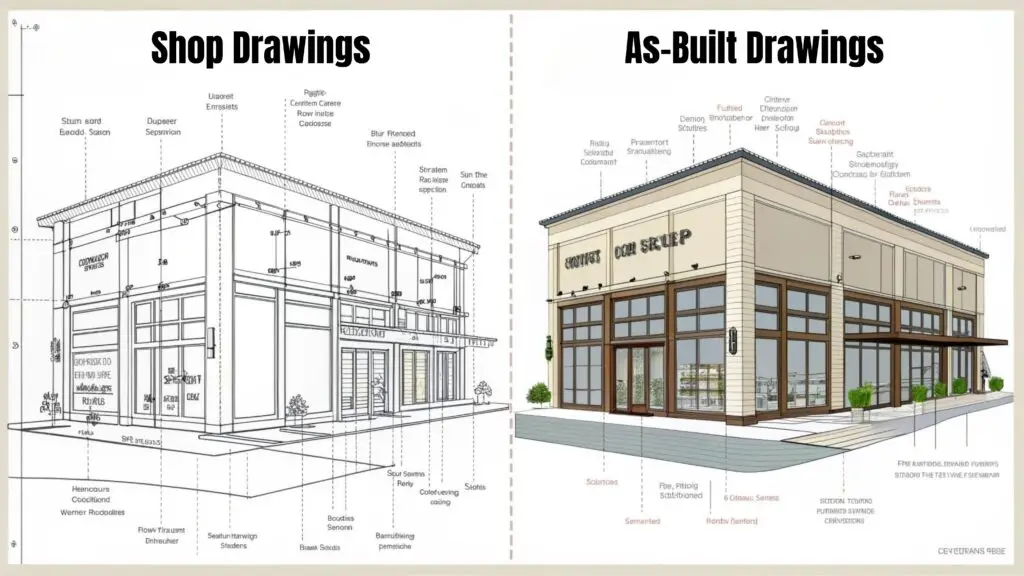
If you are a contractor, consultant, fabricator, MEP engineer, or project owner, understanding the difference between shop drawings and as-built drawings can save time, reduce site errors, and improve project documentation. This becomes even more important on complex projects where MEPF Services and BIM Services in India are involved, because coordination and documentation directly affect construction quality.
What Are Shop Drawings?
Shop drawings are detailed drawings prepared before installation or fabrication. They show how a specific system or component will actually be manufactured, assembled, coordinated, and installed on site.
These drawings go far beyond design intent drawings. The design drawings may show what needs to be built, but the shop drawings show how it will be built.
For example, in MEPF projects, shop drawings can include:
- HVAC duct routing
- Plumbing pipe layouts
- Fire-fighting system details
- Electrical conduit and cable tray coordination
- Equipment connections
- Sleeves, hangers, supports, and access requirements
Shop drawings are usually prepared by specialist contractors, subcontractors, detailers, or BIM teams. They are submitted for review and approval before execution begins.
In short, shop drawings are construction-ready drawings. They help teams verify dimensions, resolve clashes, coordinate trades, and avoid confusion during installation.
What Is an As-Built Drawing?
An as-built drawing is the final drawing prepared after installation is completed. It records what was actually built on site, including any changes made during construction.
No matter how well a project is planned, field conditions often lead to changes. A pipe may shift to avoid a beam, a duct route may change due to site constraints, or equipment may be relocated for accessibility. These real site changes must be documented properly. That is where as-built drawings come in.
An as-built drawing reflects:
- Final installed locations
- Revised dimensions
- Site modifications
- Routing changes
- Actual material or equipment used
- Final coordination conditions
These drawings are important for facility management, future renovation, maintenance work, compliance records, and handover documentation.
So while shop drawings guide installation, as-built drawings capture the final installed reality.
Shop Drawings vs As-Built Drawings: The Core Difference
Shop drawings are prepared before the work is done. As-built drawings are prepared after the work is done.
1. Purpose
The purpose of shop drawings is to help construction teams install systems accurately. They support approvals, fabrication, and coordination.
The purpose of as-built drawings is to document the final outcome of the project. They create a reliable record of the completed work.
2. Stage of Project
Shop drawings are used during the pre-construction and construction stage, before installation begins.
As-built drawings are created during and after construction, once site changes have been confirmed and the final work has been completed.
3. Content
Shop drawings contain detailed installation information such as dimensions, fabrication details, material specifications, connections, levels, and coordinated layouts.
As-built drawings contain the final field-verified condition of the installed system, including deviations from the original approved drawing set.
4. Users
Shop drawings are mainly used by contractors, subcontractors, fabricators, coordinators, and consultants during execution.
As-built drawings are mainly used by owners, facility managers, operations teams, maintenance teams, and future renovation consultants.
5. Accuracy Type
Shop drawings represent the planned installation approach.
As-built drawings represent the actual installed condition.
Why Shop Drawings Are Critical in MEPF Services
In modern projects, MEPF Services involve multiple interconnected systems working in the same physical space. Ducts, pipes, conduits, cable trays, valves, dampers, sprinklers, and equipment all compete for limited ceiling and service shaft space.
Without detailed shop drawings, site teams may face:
- Trade clashes
- Installation delays
- Rework
- Material wastage
- Poor coordination
- Difficulty in prefabrication
This is why well-prepared shop drawings are a major part of quality MEPF delivery. They make construction smoother because they convert design intent into installable information.
When created with BIM workflows, shop drawings also improve coordination across disciplines. Teams can detect clashes early, optimise routing, and produce cleaner construction documents before site execution begins.
ALSO READ: As-Built vs Record Drawings: What Is the Real Difference in Construction?
Why As-Built Drawings Matter After Construction
Many teams focus heavily on installation and forget the value of final documentation. That is a mistake.
An accurate as-built drawing is essential because the project does not end when construction ends. Buildings continue to operate for years. Maintenance teams need to know what is hidden above ceilings, inside shafts, and below slabs. Facility managers need correct layouts for servicing, renovation, and upgrades.
If as-built documentation is missing or inaccurate, future work becomes slower, riskier, and more expensive.
For example, if the actual plumbing route differs from the approved shop drawing but that change is never updated in the as-built record, a future repair team may break the wrong wall, damage another service, or waste time locating the line.
That is why as-built drawings are not just a formality. They are a long-term asset for building operations.
The Role of BIM Services in India in Both Drawing Types
Today, many contractors and consultants rely on BIM Services in India to improve both shop drawing production and as-built documentation.
For shop drawings, BIM helps by:
- Creating coordinated 3D models
- Identifying clashes before site work
- Improving spatial planning
- Supporting MEPF coordination
- Generating more accurate installation drawings
- Enabling prefabrication and modular workflows
For as-built drawings, BIM supports teams by:
- Updating the model based on final site conditions
- Recording field changes clearly
- Improving handover documentation
- Building a reliable base for facility management
- Supporting digital twin and lifecycle workflows
In complex commercial, healthcare, industrial, hospitality, and data centre projects, BIM is no longer just a design tool. It has become a documentation and coordination backbone throughout the project lifecycle.
This is why companies offering BIM Services in India often support both shop drawings and as-built drawing requirements as part of their larger construction documentation process.
Common Mistakes Teams Make
One of the most common mistakes is assuming that approved shop drawings automatically become as-built drawings. They do not.
An approved shop drawing only shows what the team intended to install. If anything changes on site, that record must be updated separately.
Another common issue is poor field mark-up management. If site teams do not record actual changes during execution, the final as-built set becomes incomplete or inaccurate.
Some projects also delay as-built updates until the end. By that time, many field decisions are forgotten. A better approach is to update changes continuously throughout construction.
When Should You Use Shop Drawings and As-Built Drawings?
You need shop drawings when the project is moving from design to execution and installation details must be finalised.
You need as-built drawings when the project is nearing completion or when final installed conditions must be documented for handover and future use.
In practice, both are necessary. One supports construction. The other supports operation and accountability.
A well-managed project does not choose one over the other. It uses both at the right stage.
Which One Is More Important?
If you want smooth execution, trade coordination, fewer clashes, and better site planning, shop drawings are essential.
If you want proper handover, reliable maintenance records, future renovation support, and long-term asset clarity, as-built drawings are essential.
So the better answer is this: shop drawings and as-built drawings are equally important, but at different points in the project lifecycle.
Final Thoughts
The difference between shop drawings vs as-built drawings is simple once you understand their role. Shop drawings help teams build correctly. As-built drawings help teams understand what was finally built.
In today’s construction environment, where projects are more technical and timelines are tighter, both documents play a major role in reducing risk and improving project quality. This is especially true in MEP-intensive buildings, where documentation affects coordination, installation, handover, and future operations.
For contractors, consultants, and developers working with MEPF Services and BIM Services in India, investing in accurate drawing workflows is not just good practice. It is a smarter way to deliver better projects.
FAQs
What is the main difference between shop drawings and as-built drawings?
The main difference is timing and purpose. Shop drawings are created before installation to show how the work will be executed, while as-built drawings are prepared after construction to show what was actually installed on site.
Are shop drawings part of design drawings?
No. Shop drawings are not the same as design drawings. Design drawings show the design intent, while shop drawings add the practical detail needed for fabrication, coordination, and installation.
Can shop drawings be used as as-built drawings?
Not directly. Shop drawings can only become part of the as-built record if all site changes are updated accurately. Without field revisions, they do not represent the final installed condition.
Why are as-built drawings important in MEP projects?
As-built drawings are important because MEP systems often undergo changes during construction. Final documentation helps maintenance teams, facility managers, and future contractors understand the real service layout.
How does BIM improve shop drawings?
BIM improves shop drawings by creating coordinated 3D models, identifying clashes, improving routing, and generating more accurate and constructible drawing sets for execution.
Why do owners ask for as-built drawings at handover?
Owners need as-built drawings because they provide a record of the completed building. This helps in operations, maintenance, troubleshooting, compliance, and future renovation work.