

ISO 19650 is one of those BIM terms that many AEC teams hear in meetings, tenders, project documents, and client requirements. For many architects, engineers, BIM modelers, contractors, and project managers, it still sounds more like a compliance document than a practical workflow.
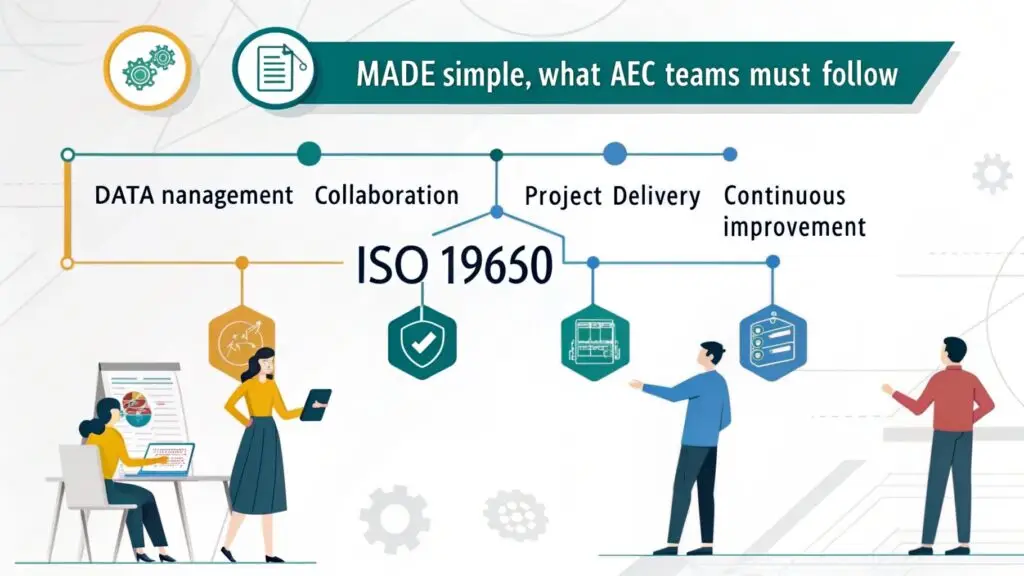
ISO 19650 is an international standard for managing project information using BIM across the lifecycle of a built asset. It helps teams decide what information is needed, who will create it, when it must be delivered, how it should be reviewed, and where it should be stored. ISO describes Part 1 as the framework for exchanging, recording, versioning, and organizing information in BIM-based information management.
For AEC teams in India working on local, Middle East, UK, US, or global BIM projects, ISO 19650 is no longer just a “nice-to-have” standard. It is becoming a practical requirement for clean BIM coordination, structured documentation, smooth approvals, and better handover.
Key Takeaways
ISO 19650 is not only about 3D models. It covers project information, drawings, models, schedules, documents, revisions, approvals, asset data, and handover information.
AEC teams must clearly define information requirements before work starts. This means the client, consultant, contractor, and BIM teams should know what needs to be produced and why.
A Common Data Environment, or CDE, plays a central role in ISO 19650 because it gives teams one controlled place to manage project information.
The standard works best when teams follow proper naming conventions, roles, responsibilities, approval workflows, revision control, and BIM Execution Plan requirements.
For Indian BIM service providers, ISO 19650 improves credibility when working with international clients because it shows that the team understands global information management practices.
What Is ISO 19650 in BIM?
ISO 19650 is a global standard for information management in the built environment using Building Information Modeling. The BSI overview explains that the ISO 19650 series covers concepts and principles, the delivery phase, the operational phase, information exchange, and security-minded information management.
When a construction project starts, everyone creates information. Architects create design models and drawings. Structural engineers create structural models and calculations. MEP teams create HVAC, plumbing, electrical, and fire protection models. Contractors create shop drawings, schedules, RFIs, submittals, quantity takeoffs, and installation documents.
Without a system, this information becomes messy. Files get renamed randomly. Revisions get missed. Teams work on outdated models. Clash reports are not tracked properly. Site teams receive incomplete drawings. Facility teams get poor handover data.
ISO 19650 solves this by creating a controlled way to manage information from project start to asset operation.
Why ISO 19650 Matters for AEC Teams
AEC projects are getting larger, faster, and more data-heavy. A hospital, airport, metro station, data center, high-rise, or industrial plant can involve hundreds of models, drawings, schedules, documents, and approvals.
Teams start facing common problems such as:
- Design teams working on outdated files
- MEP clashes found late during construction
- Wrong drawing revisions issued to site
- BIM models not matching project requirements
- Consultants using different naming formats
- Contractors losing time in document tracking
- Facility teams receiving incomplete asset data
ISO 19650 gives structure to all of this. It helps teams move from “file sharing” to “information management.”
ISO 19650 Is Not Only for Big Projects
Many people think ISO 19650 is only for airports, rail projects, government buildings, or mega infrastructure. That is not true.
The standard is most visible on large projects, but the logic applies to smaller projects too. Even a residential tower, commercial office, school, hospital block, warehouse, or hotel project needs clean information control.
A small project may not need a very complex BIM information management system. But it still needs:
- A clear BIM Execution Plan
- A controlled file naming system
- A shared location for information
- Defined responsibilities
- Model review and approval process
- Revision tracking
- Final handover information
So, the goal is not to overcomplicate the project. The goal is to apply the right level of control based on project size, client requirements, and delivery scope.
Main Parts of ISO 19650 Explained Simply
The ISO 19650 series is divided into different parts. Each part focuses on a specific area of information management. BSI summarizes the suite as covering concepts and principles, delivery phase, operational phase, information exchange, and security.
Here is the simple version.
| ISO 19650 Part | Simple Meaning | Why It Matters |
| ISO 19650-1 | Concepts and principles | Explains the overall information management framework |
| ISO 19650-2 | Delivery phase | Guides information management during design and construction |
| ISO 19650-3 | Operational phase | Supports asset information during operation and maintenance |
| ISO 19650-4 | Information exchange | Focuses on how information should be exchanged properly |
| ISO 19650-5 | Security-minded approach | Helps protect sensitive project and asset information |
Right Information, Right People, Right Time
ISO 19650 is built around a very practical idea: project teams should deliver the right information to the right people at the right time.
Similarly, the facility management team does not just need as-built drawings at handover. They need reliable asset data such as equipment tags, manufacturer details, maintenance information, warranty data, location data, and system relationships.
ISO 19650 pushes teams to think about information as a project deliverable, not as a side product of design.
What AEC Teams Must Follow Under ISO 19650
1. Define Information Requirements Before Work Starts
The first step is to define what information is actually required. Many BIM projects fail because teams start modeling before the client’s information needs are clear.
Under ISO 19650, the appointing party, usually the client or asset owner, should define what information they need from the project team. This may include design models, drawings, schedules, asset data, COBie sheets, clash reports, quantities, maintenance data, or handover records.
2. Understand the Key ISO 19650 Roles
ISO 19650 uses specific terms for project roles. These terms may sound technical, but they are easy to understand.
The appointing party is usually the client, owner, developer, or organization asking for the project information.
The lead appointed party is often the main consultant, lead designer, general contractor, or BIM lead organization responsible for managing information delivery.
The appointed parties are the teams or companies appointed to create and deliver information. This may include architects, structural engineers, MEP consultants, BIM consultants, contractors, subcontractors, and suppliers.
3. Create a BIM Execution Plan
A BIM Execution Plan, or BEP, is one of the most important documents in an ISO 19650-aligned project.
A BEP explains how the BIM process will be managed. It should not be a generic template copied from another project. It must reflect the actual project scope, team structure, delivery stages, software, model uses, coordination workflow, and information exchange requirements.
A BEP is not just documentation. It is the operating manual for BIM delivery.
4. Use a Common Data Environment
A Common Data Environment, or CDE, is a controlled digital space where project information is stored, reviewed, shared, approved, and archived.
A CDE may be managed through platforms such as Autodesk Construction Cloud, BIM 360, ProjectWise, Asite, Trimble Connect, or other document control systems, depending on project requirements.
The CDE is important because it avoids scattered information. Without it, some files stay on email, some on WhatsApp, some on local drives, some on cloud folders, and some inside individual software platforms. That creates confusion.
5. Follow Proper Naming Conventions
File naming may look like a small issue, but in BIM projects, it is a big control point.
A poor file name like Final_Model_New_Updated_Rev3_Last.rvt creates confusion. Nobody knows the discipline, originator, level, zone, status, or revision.
ISO 19650 encourages structured information containers. A model, drawing, schedule, report, or document should be named in a way that helps the team understand what it is without opening the file.
6. Control Revisions and Status Codes
In construction, using the wrong revision can cause serious cost and site issues. A beam opening may shift. A duct route may change. A ceiling height may be revised. A plumbing riser may move. If the site team uses an old drawing, rework becomes almost guaranteed.
ISO 19650-aligned workflows require proper revision and status control.
This is especially useful during BIM coordination. A model shared for coordination should not automatically be treated as approved for construction. Similarly, a drawing issued for review should not be used for installation unless it has the correct approval status.
7. Manage Level of Information Need
Many teams still use the term LOD casually, but ISO 19650 pushes teams toward defining the Level of Information Need. This means teams should only produce the amount of information required for a specific purpose.
More detail is not always better.
For concept design, the model may only need massing, major spaces, and basic system routes. For coordination, the model needs accurate geometry, clearances, equipment locations, and discipline interfaces. For fabrication or shop drawings, the model may need supports, hangers, spools, sleeves, and installation-level details.
8. Plan Information Delivery with MIDP and TIDP
ISO 19650 expects project teams to plan information delivery properly. This is where documents like the Master Information Delivery Plan and Task Information Delivery Plan become useful.
A TIDP is usually prepared by each task team. It explains what that team will deliver and when.
A MIDP combines all task team deliverables into a master project-level delivery plan.
9. Keep Model Coordination Structured
ISO 19650 supports better BIM coordination because it forces teams to manage information with clarity.
10. Secure Sensitive Project Information
Some projects include sensitive information. Airports, data centers, defense buildings, government facilities, hospitals, and industrial plants may have security-sensitive layouts, systems, and operational data.
11. Prepare Handover Information Early
One of the biggest mistakes in AEC projects is treating handover as a last-month activity. By that time, teams rush to collect drawings, O&M manuals, asset data, warranties, and as-built information.
ISO 19650 encourages teams to think about asset information from the beginning.
If the facility team needs equipment tags, serial numbers, manufacturer details, maintenance schedules, asset locations, and warranty information, the project should define this early. Otherwise, the BIM team may create a model that looks good but does not support operations.
Practical ISO 19650 Checklist for AEC Teams
| Requirement | What to Check |
| Information requirements | Has the client clearly defined what information is needed? |
| BIM Execution Plan | Is there a project-specific BEP? |
| Roles and responsibilities | Does every team know who creates, reviews, and approves information? |
| CDE setup | Is there one controlled platform for project information? |
| Naming convention | Are models, drawings, and documents named consistently? |
| Revision control | Is every file controlled with proper revision and status? |
| Model coordination | Is the clash detection and issue tracking workflow defined? |
| Delivery schedule | Are TIDP and MIDP prepared and aligned with project milestones? |
| Security | Is sensitive information protected with access control? |
| Handover | Are asset data and as-built requirements defined early? |
ALSO READ: Common Data Environment (CDE): Single Source of Truth for AEC
Common Mistakes AEC Teams Make with ISO 19650
Many teams say they follow ISO 19650, but in practice they only follow parts of it. That weakens the whole process.
One common mistake is treating ISO 19650 as a documentation exercise. Teams create a BEP, upload it, and forget it. That does not work. The BEP must guide daily coordination, model exchange, review, approval, and handover.
Another mistake is using a CDE like a normal cloud storage folder. A real CDE workflow needs status control, revision control, permissions, approvals, and traceability.
Many teams also start modeling before understanding information requirements. This leads to rework because the client may later ask for different data, formats, classifications, or handover outputs.
AEC teams should also avoid over-modeling. A highly detailed model is not automatically a better model. The model should match the required purpose and project stage.
ISO 19650 and BIM Coordination
BIM coordination becomes more reliable when ISO 19650 principles are followed.
If the architecture model is outdated, the structural model is not approved, and the MEP model has no status code, clash detection results become unreliable. The coordination team may spend hours reviewing clashes that are already obsolete.
ISO 19650 improves BIM coordination by making sure:
- Models are shared at agreed-upon times
- Each model has a clear status
- Teams use the correct revision
- Issues are assigned to the responsible parties
- Coordination comments are tracked
- Approved information is separated from work-in-progress information
This creates a better workflow for architects, engineers, BIM coordinators, general contractors, and trade contractors.
Benefits of Following ISO 19650
ISO 19650 helps AEC teams improve project delivery in several ways.
It reduces confusion because every team follows one information structure. It improves accountability because roles and responsibilities are defined. It supports better coordination because model exchanges are planned and controlled. It improves quality because reviews and approvals are traceable.
It also helps contractors avoid costly rework. When teams work from correct information, site execution becomes more reliable. Drawings, models, and documents are easier to track. RFIs reduce when information is clear. Handover becomes easier because data is collected throughout the project instead of at the last minute.
For owners and developers, ISO 19650 improves long-term asset value. They receive better information for operations, maintenance, renovation, and future expansion.
Final Thoughts
ISO 19650 may look complex at first, but its purpose is simple: to manage project information properly.
AEC teams do not fail only because of poor design. They also fail because of poor information control. Wrong files, unclear responsibilities, outdated revisions, missing approvals, and weak handover planning can damage even a well-designed project.
ISO 19650 gives teams a better way to work. It brings structure to BIM delivery, document control, coordination, approvals, and asset information. For Indian AEC firms working on BIM projects, especially with international clients, understanding ISO 19650 is a serious competitive advantage.
The best way to start is not by making the process complicated. Start with the basics: define information requirements, assign responsibilities, prepare a practical BEP, use a proper CDE, control revisions, and plan handover early.
FAQS
Is ISO 19650 only for BIM projects?
ISO 19650 is mainly used for BIM-based information management, but it covers more than 3D models. It also applies to drawings, documents, schedules, reports, asset data, and other project information.
Why is ISO 19650 important for AEC teams?
It helps AEC teams avoid confusion, reduce rework, improve coordination, manage revisions, control approvals, and deliver better handover information to clients and facility teams.
What is a CDE in ISO 19650?
A CDE, or Common Data Environment, is a controlled digital platform where project information is stored, reviewed, shared, approved, and archived. It helps teams avoid scattered files and outdated information.
What is the role of a BIM Execution Plan in ISO 19650?
A BIM Execution Plan explains how the project team will manage BIM and information delivery. It covers roles, software, model standards, naming rules, coordination workflow, CDE use, deliverables, and approval processes.
Can Indian BIM companies follow ISO 19650?
Yes. Indian BIM companies can follow ISO 19650 to align with global BIM delivery standards. It is especially useful when working with clients from the UK, USA, Middle East, Canada, Australia, and other international markets.