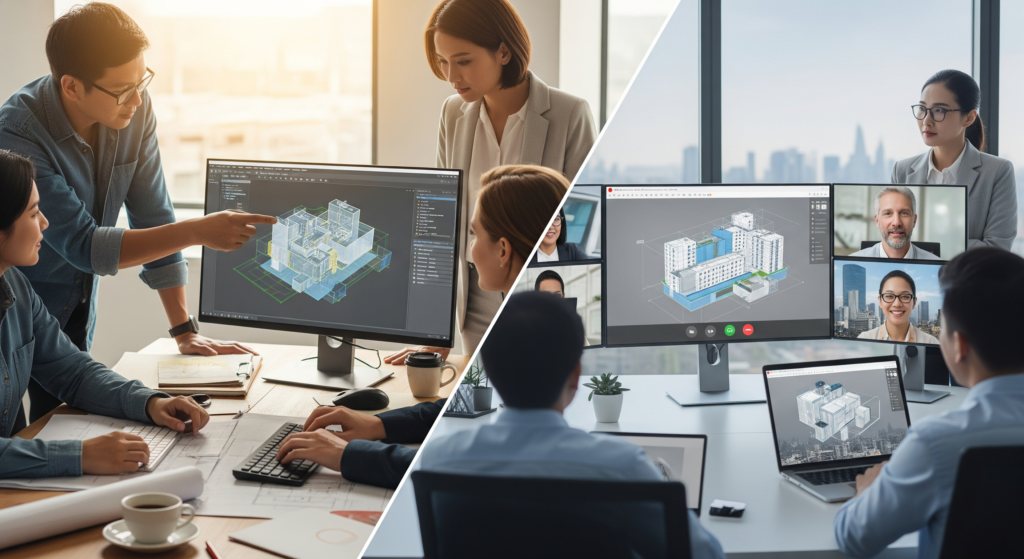
If you’re leading BIM on real projects, you already know the truth: BIM is not “just modeling.” It’s production pressure, coordination pressure, and decision pressure, often all at the same time. One week, you need Drafting Services to convert markups into clean sheets. Next week, the GC wants 3d clash coordination wrapped up before the ceiling rough-in. Then fabrication asks for Shop Drawing packages, while the structural team pushes late revisions that force fresh Structural Modeling services.
So the big question becomes: Do you build an in-house BIM team, or do you scale faster with a BIM Outsourcing Company / BIM outsourcing company partner? The right answer depends on what you’re building, how often you need it, and how much risk you can absorb.
This guide breaks it down with clear tradeoffs, real AEC workflows, and a simple decision framework you can actually use.
First, what “BIM outsourcing” really means in AEC
In most AEC firms, outsourcing doesn’t mean handing off your project brain. It means handing off repeatable production + specialist bandwidth, while your core team keeps control of intent, standards, and sign-offs.
- Shop Drawing services (MEP shop drawings, hanger details, penetration drawings, spool-ready sheets)
- 3d clash coordination and 3d clash detection (trade coordination, Navisworks runs, issue tracking)
- Drafting Services (2D extraction, sheet setup, redline updates, CAD-to-Revit conversion)
- Structural Modeling services (Revit/Tekla models for coordination, LOD upgrades, documentation-ready models)
Many BIM partners also deliver models in multiple exchange formats and LOD ranges (LOD 200 to LOD 500), depending on your requirement and downstream use.
Why this decision matters more than ever
The BIM market has matured. Clients, GCs, and trade partners don’t just want “a model.” They want:
- Fewer RFIs
- Fewer site clashes
- Faster shop approvals
- Cleaner installation drawings
- Better coordination meetings
That’s why firms increasingly split BIM into two tracks:
- Core BIM leadership (in-house): standards, BEP, client communication, coordination strategy
- Production engine (in-house or outsourced): modeling, updates, sheets, clash runs, shop drawings
In-house BIM team: when it’s the smarter move
Building in-house is worth it when BIM is core to your differentiation or constant across projects.
Build in-house if you need tight control over:
1) Design intent and rapid iteration
If your architects/engineers iterate daily, internal BIM keeps the loop tight. Outsourcing can slow you down if scope changes are frequent and undocumented.
2) Standards, templates, and QA culture
If your deliverables must match your internal library, naming rules, and documentation style every single time, in-house teams enforce that naturally—especially when deadlines hit.
3) High-context coordination
Some coordination needs deep project memory—why a route exists, what the PM promised, what the client rejected last month. That context is hard to transfer.
4) Long-term capability
If you want BIM to become a permanent capability (not a project-by-project cost), internal hiring and training builds institutional strength.
The hidden cost of in-house (be honest about this)
In-house teams are not just salaries. You’re also paying for:
- Hiring time + replacements when people leave
- Training + BIM standards development
- Revit/Navisworks setup, add-ins, libraries
- Workstations and model management discipline
- Peaks and valleys (idle time between deadlines)
If your workload is inconsistent, you end up paying full-time costs for part-time utilization. That’s where outsourcing starts to win.
Partnering with a BIM outsourcing company: when it’s the smarter move
Outsourcing makes sense when you need speed, scale, or specialist output without building a large internal department.
Partner with a BIM Outsourcing Company if:
1) You have peaks in workload
Tender season, permit deadlines, or coordination rush periods can double your output needs overnight.
2) You need predictable delivery
A mature outsourcing partner runs like a production line: defined inputs, defined outputs, defined QA.
3) You need specialists fast
For example:
- Dedicated 3d clash coordination teams running issue workflows
- Specialist Shop Drawing teams who understand BOP/BOD, slopes, offsets, hangers, and field points
- Structural modelers who can work confidently in Revit/Tekla
4) You want time-zone advantage
Many firms use an overnight cycle: you send markups end-of-day, and wake up to updated models/sheets.
The real tradeoff: control vs speed (and how to balance it)
Here’s the blunt truth: outsourcing doesn’t fail because of talent. It fails because of unclear ownership.
You must decide who owns:
- BIM execution plan and standards
- Coordination strategy and meeting decisions
- Model QA acceptance criteria
- Design responsibility vs modeling responsibility
- RFI log ownership and closeout workflow
A good outsourcing setup protects your control while still giving you speed.
A simple decision framework you can use
1) Is BIM output constant or seasonal?
If constant → in-house becomes logical.
If seasonal → outsourcing gives flexible capacity.
2) Is your BIM standard mature?
If yes → outsourcing plugs into it smoothly.
If no → build core standards in-house first, then outsource production.
3) Are you doing coordination-heavy work?
If you run lots of inter-trade reviews, a partner that specializes in bim coordination services and clash workflows can deliver faster.
4) Are your deadlines tight but scope stable?
Stable scope + tight deadline is perfect for outsourcing.
5) Do you need fabrication-ready accuracy?
If yes, pick a partner experienced with shop-level outputs (not just “pretty models”).
6) Do you have one BIM lead internally?
If you have at least one strong internal BIM lead, outsourcing becomes much safer because someone controls the funnel.
7) Is this capability strategic for you long-term?
If BIM is a profit center for you, invest in-house. If BIM supports your main service, outsource the heavy lift.
What to outsource first (based on real AEC workflows)
1) Drafting Services: the easiest win
Drafting is highly process-driven:
- Convert PDF markups into clean sheets
- Extract documentation from models
- Convert sketches/CAD into 3D variants
That’s why Drafting Services are one of the first scopes firms outsource, it’s measurable and easy to QA.
Keep in-house if drafting is deeply tied to design iteration every day.
Outsource if drafting is volume-heavy and standards are clear.
2) 3d clash coordination: outsource it if you want consistency
Clash coordination isn’t just running Navisworks. It’s managing the entire loop:
- Run clash tests
- Group/triage issues
- Assign ownership
- Track closures
- Prepare coordination meeting packs
Clash coordination as early detection/management between trades, reducing post-modeling adjustments and saving time and cost.
Keep in-house if your coordination meetings are high-stakes and require strong internal authority.
Outsource if you want consistent weekly clash cycles with clear reporting and issue tracking.
3) Shop Drawing: outsource when you need field-ready speed
Shop drawings are where mistakes hurt the most—because they hit fabrication and site installation.
Shop Drawings come from a coordinated BIM model and include critical install data like BOP/BOD, TOP/TOD, slopes, flow direction, offsets, sections, elevations, penetration drawings, hangers, sleeves, and even field points.
Keep in-house if your team is also responsible for means-and-methods and wants tight control of constructability decisions.
Outsource if you need fast, repeatable drawing production from a coordinated model, with strong QA.
4) Structural Modeling services: outsource for coordination, not engineering sign-off
Structural BIM is powerful for coordination and planning. It also supports integration with other disciplines.
Structural teams using Revit/AutoCAD/Tekla to convert schematics and construction set drawings into 3D Revit models.
Important boundary: outsource modeling and coordination support, but keep structural engineering design authority and stamping decisions where they belong.
The best setup for most firms: a hybrid model
Most AEC teams win with this structure:
In-house (small, strong core)
- BIM manager / BIM lead
- Standards + templates
- BEP + coordination strategy
- Final QA + client communication
Outsourced (scalable production)
- Drafting Services
- Model updates and LOD upgrades
- 3d clash coordination cycles
- Shop Drawing packages
- Structural Modeling services for coordination
This gives you control without hiring a full army.
How to make outsourcing actually work (without rework)
Here’s the operating system you need:
1) Start with a BEP and clear scope
A good coordination service starts by defining roles, file exchange, and LOD through a BIM Execution Plan (BEP).
2) Define acceptance criteria (QA checklist)
Don’t say “good model.” Say:
- Naming conventions
- Worksets
- LOD requirements
- Clash tolerances
- Sheet standards
- Annotation rules
3) Use a shared CDE and issue workflow
When clash coordination teams use tools like BIM 360, Navisworks, and issue tracking platforms, it creates repeatable coordination cycles.
4) Assign one internal “single point of truth”
One person should approve:
- Changes that impact design intent
- Major reroutes
- Constructability decisions
- Final shop drawing release
5) Run a pilot before scaling
Start with one zone, one floor, or one system. If the partner performs, scale.
Choosing the right BIM outsourcing company (what to check)
When evaluating a BIM outsourcing company, look beyond the portfolio images and ask:
- Can they show sample Shop Drawing sets with real install annotations?
- Do they have a defined clash workflow (triage → assign → close)?
- Do they work with your tools and CDE?
- Do they document assumptions and RFIs clearly?
- Do they have QA stages before sending outputs?
FAQs
1) What should I outsource first in BIM Services?
Start with Drafting Services and controlled production tasks. Then move into 3d clash coordination cycles. After that, expand into Shop Drawing packages when standards are stable.
2) How does 3d clash coordination reduce site issues?
It finds conflicts early between trade and federated models, so teams solve them before installation, reducing rework and delays.
3) Can outsourced structural modeling replace a structural engineer?
No. Structural Modeling services support coordination and documentation, but engineering design authority stays with licensed professionals.
Final take: build control in-house, scale production with a partner
If you want the cleanest outcome, don’t treat this as “in-house vs outsource” like it’s a fight. Treat it like a system design.
- Keep strategy, standards, and decisions in-house.
- Scale production output with a capable BIM outsourcing company.
- Use a hybrid model so you stay fast without losing control.
That’s how teams deliver better Shop Drawing packages, tighter 3d clash coordination, consistent Drafting Services, and reliable Structural Modeling services, without burning out internal staff or missing deadlines.