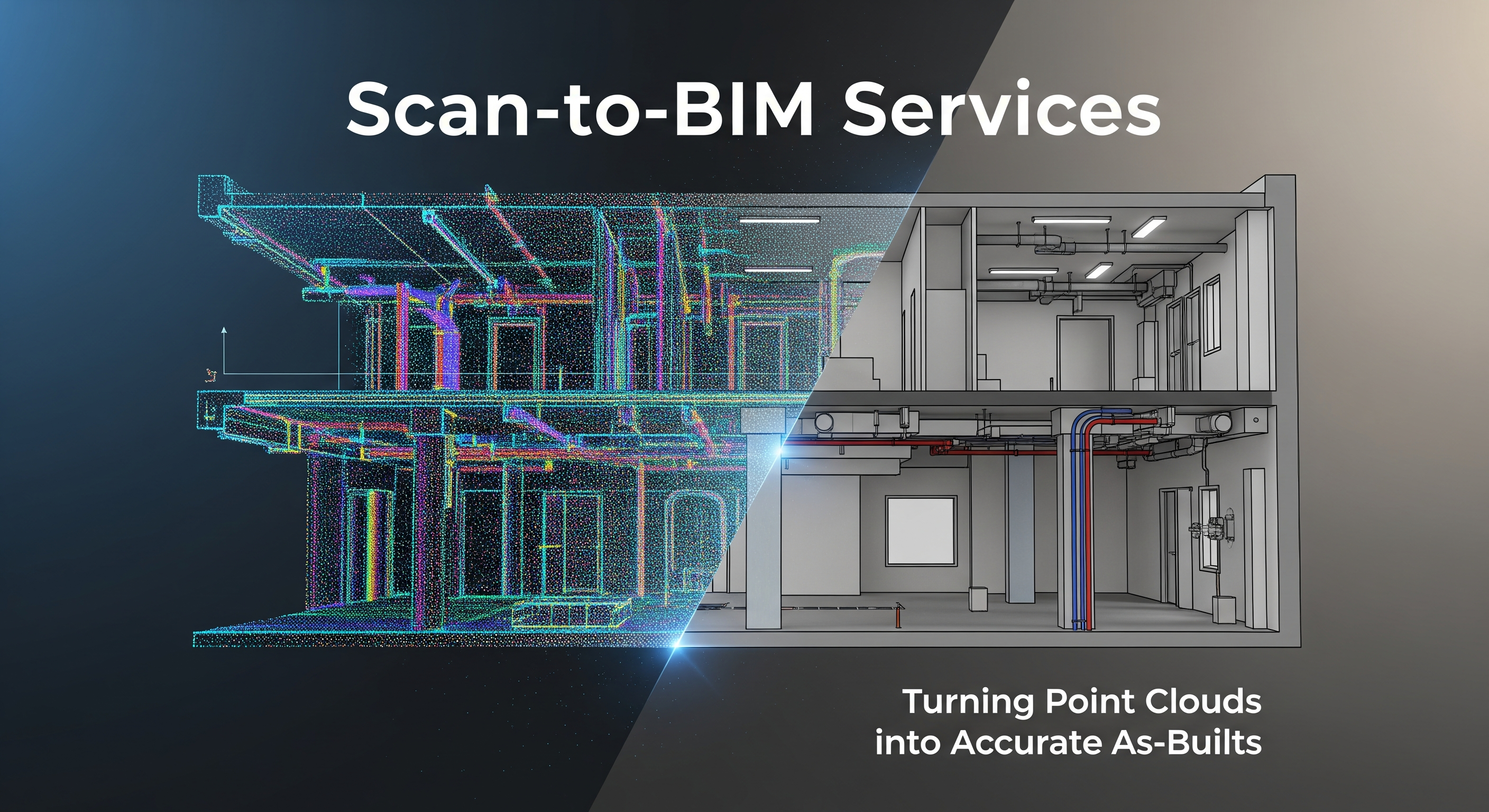

You can’t coordinate today’s work with yesterday’s measurements. Scan to BIM converts site reality into a model teams can trust, from brownfield renovations to hospital fit-outs.
Capture: getting “field truth” right
Use a 3D laser scanner for buildings to capture overlapping scans with targets or on-board SLAM. Aim for coverage on penetrations, slab edges, soffits, hangers, and equipment footprints, the things that cause clashes. A good 3D laser scanning services partner also plans sightlines so you’re not guessing about blind spots later.
Register and clean the data
Registration aligns scans into a single coordinate space with survey control. Remove stray points, set levels, and clip regions so the cloud is lightweight and useful. If the project requires fast cloud access, consider hosting/streaming (then link clean sections into Revit for modeling).
Model what matters (and only what matters)
Define target LOD/LOI by discipline. For structural capture grids, columns, beams, slab edges, camber, and openings. For architectural purposes, model walls, doors, windows, slab steps, stairs, ceiling planes, and enough for Architectural BIM Services and coordination with MEP. For MEPF, prioritize mains, equipment, and critical branches; don’t bloat the model with every saddle unless it drives coordination or shop drawing services.
QA that earns confidence
- Dimension checks: Compare key spans and elevations to point-cloud sections.
- Clash checks: Run BIM coordination services to detect offsets (e.g., vertical risers through beams).
- Field sign-off: superintendent/foreman review of critical locations before issuing as built drawings.
Deliverables owners actually use
- Coordinated Revit model linked to your Common Data Environment.
- As built services package: annotated plans, 3D views, and room-by-room deviations.
- Optional visuals: 3D rendering or 3D rendering services showing design within a real context, helpful for stakeholder approvals.
Why not just measure manually?
Manual tape/total station workflows miss out-of-plumb, slab warp, or undocumented penetrations. Point clouds expose the truth quickly, cutting site revisits and late RFIs. And when teams need 2D CAD drafting services, convert the model to sheets without re-measuring. Bottom line: Accurate scan to BIM is a process of smart capture, disciplined registration, and intentional modeling. Do those three well, and coordination becomes proactive, not reactive.